The central economic question is simple: does the company actually own the code, designs, documentation, and related intellectual property created for the project?
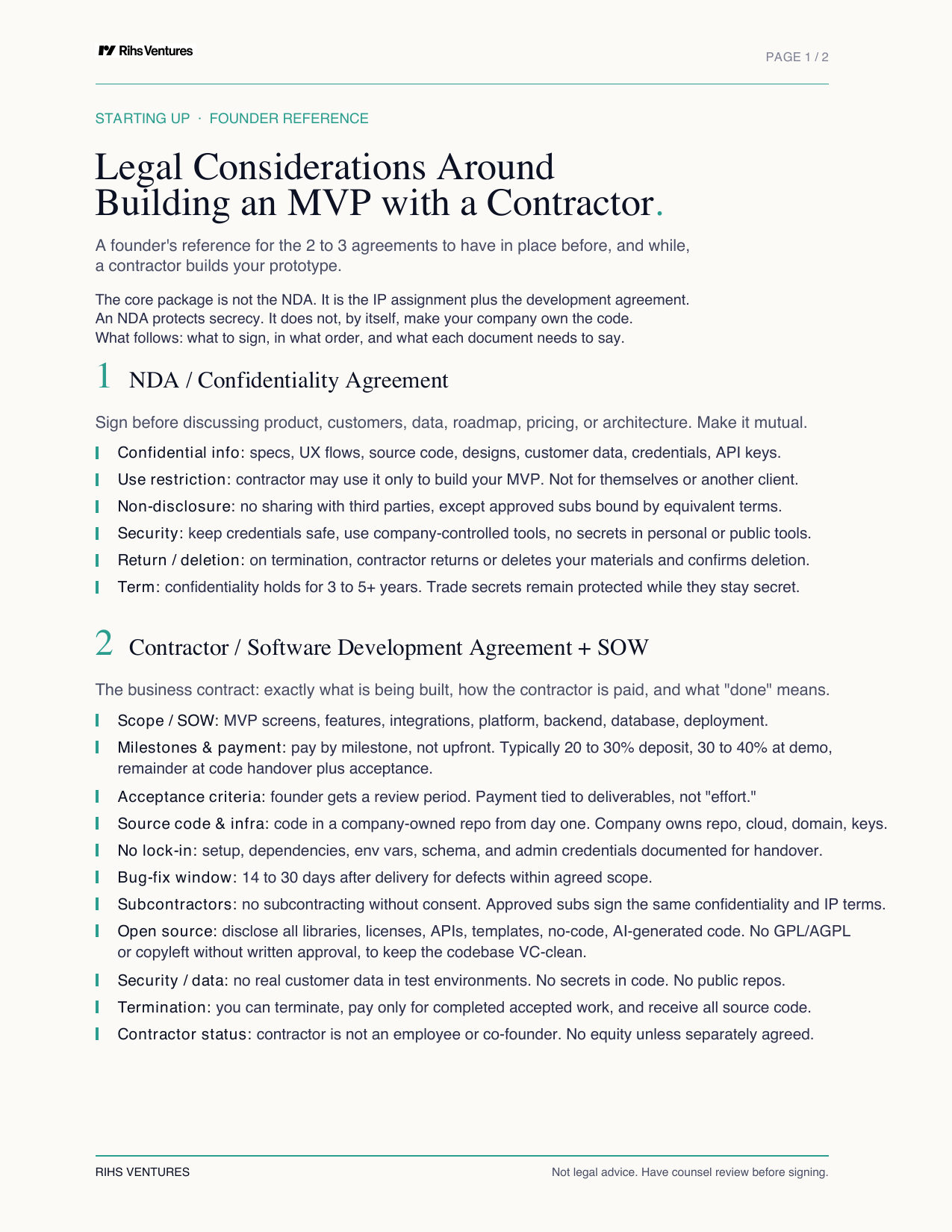
1. NDA and confidentiality
Sign before discussing product logic, customer information, data, pricing, workflows, credentials, or technical architecture. The agreement should restrict use of confidential information to the project, control disclosure to subcontractors, and require secure handling and deletion.
2. Contractor agreement and SOW
This is the business contract. It defines what is being built, how payment works, and what done means. Scope, milestones, acceptance criteria, source-code access, infrastructure ownership, documentation, open-source dependencies, and the bug-fix window should be explicit.
Keep the repository, cloud accounts, domain, database, analytics, API keys, and payment infrastructure under company control from the beginning. A clean handover is part of the deliverable.
3. IP assignment
The agreement should state that the contractor assigns all rights in the work product to the company. Work product should include code, interface design, architecture, database design, algorithms, prompts, workflows, documentation, and derivative works.
Pre-existing tools can remain with the contractor, but they should be disclosed and licensed broadly enough that the company can continue operating, financing, and selling the product without lock-in.
All work product created for the project should be assigned to the company, with any retained pre-existing tools disclosed and broadly licensed.
4. The minimum stack
- NDA: before detailed discussions.
- Software development agreement and SOW: before work starts.
- IP assignment: standalone or included as an explicit exhibit.
Investor diligence will ask whether the company owns the code. The point of this stack is to make the answer clear.